Xi’an, 5th of April 2026.
The story of this trip is somehow curious. In 2025 I saw in the news that there had been a half marathon with humans running next to humanoid robots in Beijing… so I decided we had to be there!
So I looked for information, signed up for wechat (the platform to use) and entered the draw, but I was not succesful. There were 12,000 spots and more than 32,000 people had entered the draw. No luck for us! But, guess what? We decided to travel to China anyway and see the robots running!
And make a trip out of it. Visit Xi’an instead, which was a dream of mine!
TLDR; “too long, didn’t read”
- I just want to run! Take me to RUN.
- I have 1 minute. Take me to USEFUL INFORMATION.
- Running is my excuse for travelling. Take me to TRIP.
- Running is my excuse for eating. Take me to CARBOLOADING.
- I want to know what to read in the plane. Take me to ONE BOOK.
🌍 The Trip 📷
A Tapestry of Ancient Dynasties
The vast history of China stretches across thousands of years of imperial rule and dramatic cultural shifts. 📖 You can feel the weight of the past in every massive stone gate and narrow alleyway within the older neighborhoods. 🏛️
This deep heritage provides a stunning backdrop for modern runners who want to explore the roots of human civilization. 🌏
The Pulse of Modern Progress
China is now a land of incredible contrasts where traditional tea houses sit beside soaring neon glass skyscrapers. 🏙️ The sheer speed of development has transformed the urban landscape into a futuristic playground for the world to see. ⚡
Navigating these high tech cities offers a unique perspective on how quickly a society can reinvent its own future. 🚄
Getting to Xi’an
We arrived in Shanghai with a direct flight from Barcelona: China Eastern Airlines. 12 hours; decent food, but not a lot of movies available. Because of the lack of options, I watched a Danish film, “Team Havnaa”, which was actually pretty cool.
In Shanghai we had to pass customs; we had to fill an e-form and everything went smoothly. We Spaniards do not require a visa at present.
We had a flight to Xi’an in the same airport, Shanghai Pudong, and we transferred without problems… except for the fact that we had to leave Roger’s power bank at the security check. Not allowed! Water is also not allowed so Roger drank up 2 liters in 2 minutes.. and he later paid the price. He was sick for a day afterwards!
Then another China Eastern Airlines flight, 2 hours long, and we were in Xi’an at 9:30am.
We made it to Xi’an!
It was a cloudy and fresh April day.
We had hired a private tour to see the Terracotta warriors and it was very good. Nice car, timely transfers, and Annie, our guide, who spoke perfect English and was super nice. She asked us a lot of questions about America, Europe and Mexico (because she had had some Mexican customers the day before).
Hearing what she remarked, we got a very good view of what people know and think about “the West” in China. It was fascinating!
We exchanged trivia as well, and I even got to explain who Francisco de Goya was, and told her proudly about his “Black paintings”, because there was an exhibition in the Xi’an museum! (Alongside Durer, Rembrant and Kate Kollwitz – nice!).
Terracotta Warriors: Not just the statues!
We first went to the Terracotta warriors. This was what we came here to see, the so called “8th wonder of the World”, and it was truly exceptional.
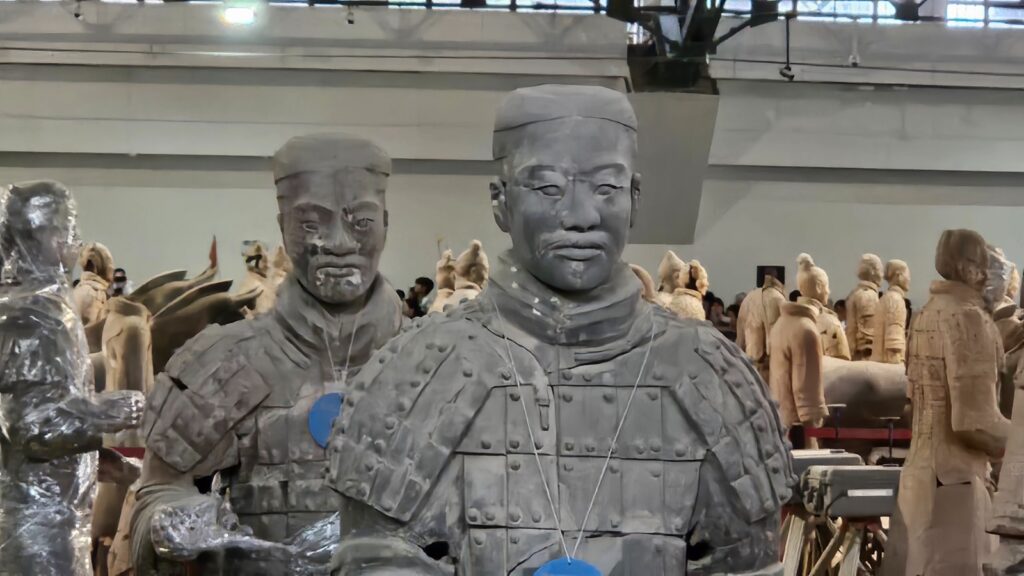
Visiting was also an experience in itself, as it was crowded. It was a Saturday and we had to LITERALLY fight our way to see anything. Security wards were blasting orders with megaphones very loudly, and everybody was shouting and pushing. Pushing a lot 😉 Tourism the Chinese way 🤣🤣.
Annie remarked: “You Europeans are so polite!”. We might be, but we are also Spaniards: we adapt quickly to the pushing… So I went all in and fighted my way to see a statue of a “general”, in Pavillion 2, which was inside a glass vitrine, and most probably the most photographed statue.
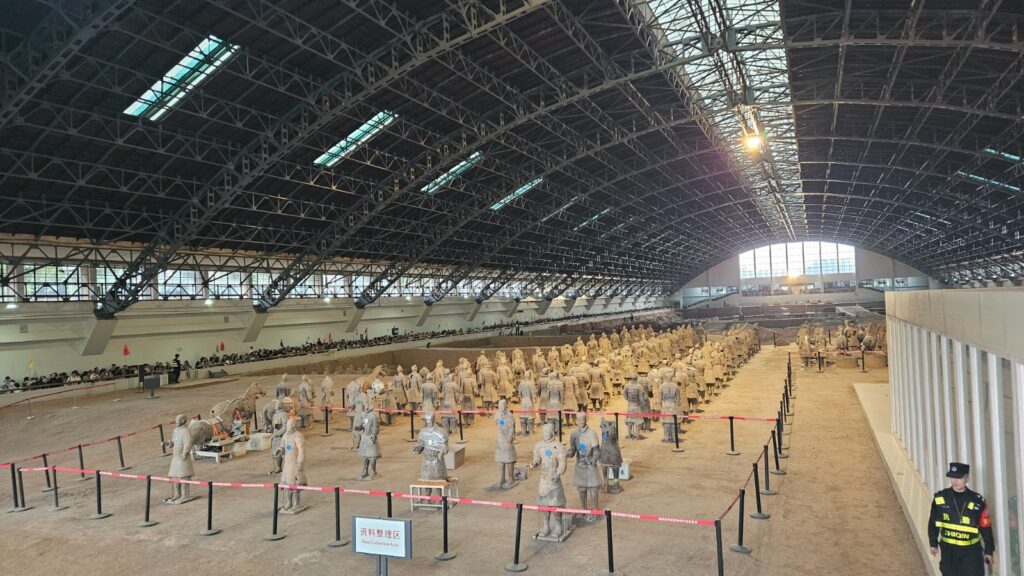
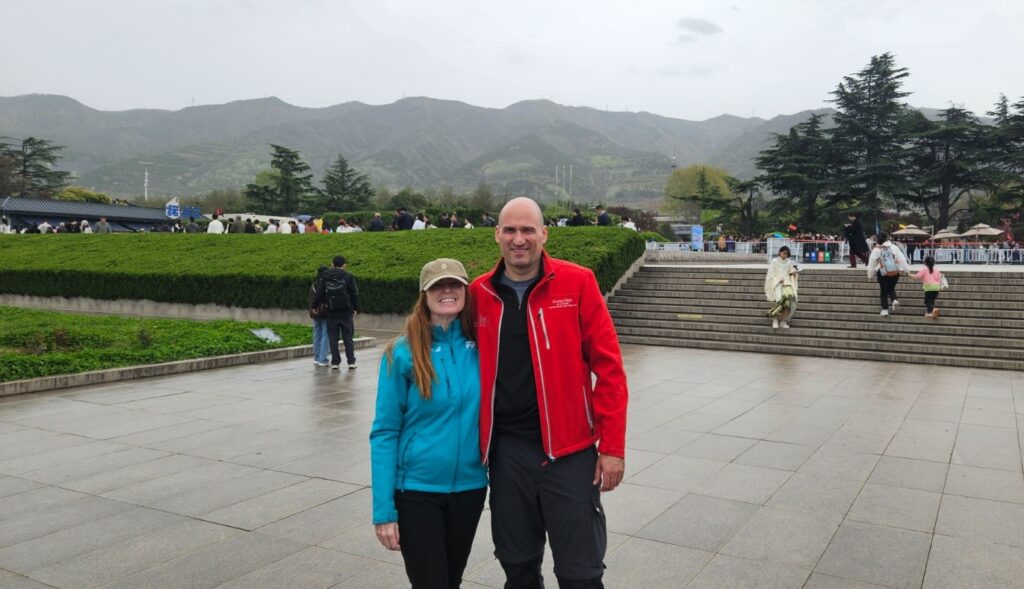
First of all; the setting is amazing. It is within mountains and a river, because it’s traditionally a lucky location, so ideal for the first Qin Emperor to be buried. Although it was cloudy, the view of the green rolling mountains was typically Chinese. Beautiful!
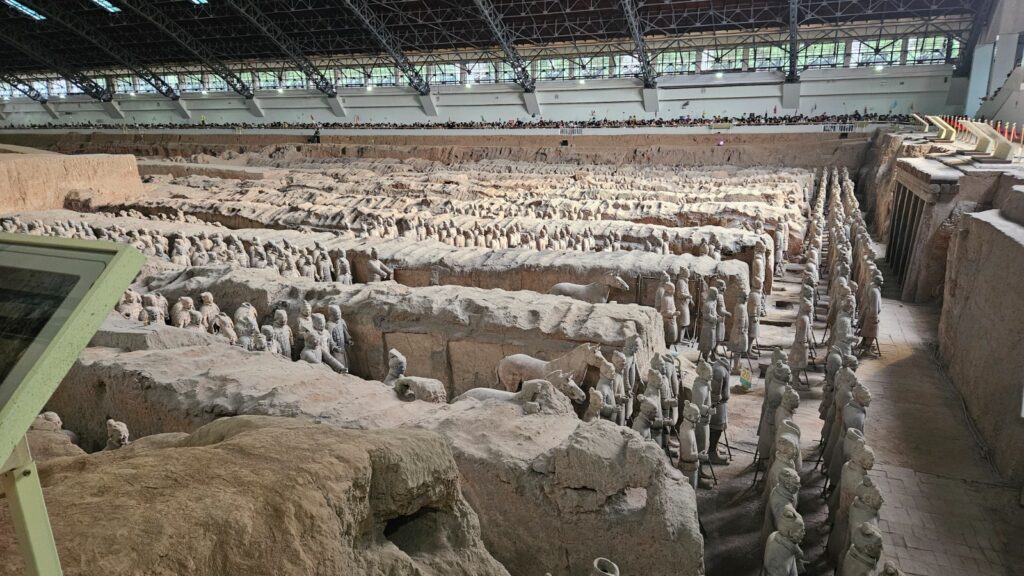
Then we saw the 3 Pavillions; the 1st one, the biggest, is the most famous. Despite the CHAOS, we did see the warriors 😜 . And Annie showed us a tik tok video of when a German guy disguised himself as a warrior and sneaked into the rows of statues and was able to be there for 3 hours-?! before an old lady spotted him!
First Qin Emperor’s Mausoleum
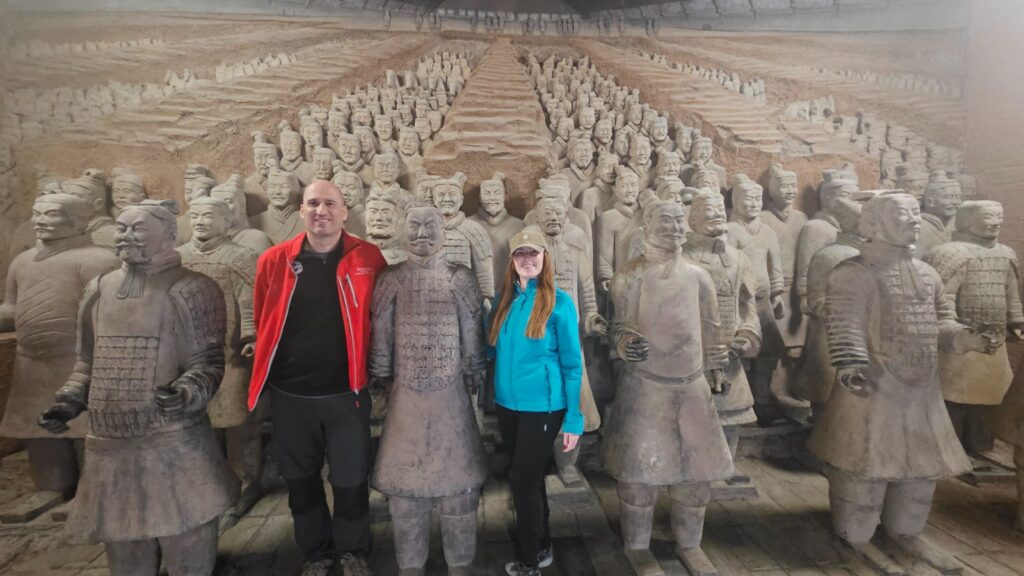
We then went to try the 3D experience of the Emperor’s Mausoleum. It was cool to do it as the Mausoleum is buried beneath a man-made mountain and has not been explored yet! Truly fascinating; apparently it’s a hidden, secret wonder, and it has giant coloured statues of generals, libraries, treasures, rivers of mercury (poisonous, indeed), and all kinds of booby traps, some with crossbows!….
Seriously; how cool is that?!?!
The farmer!
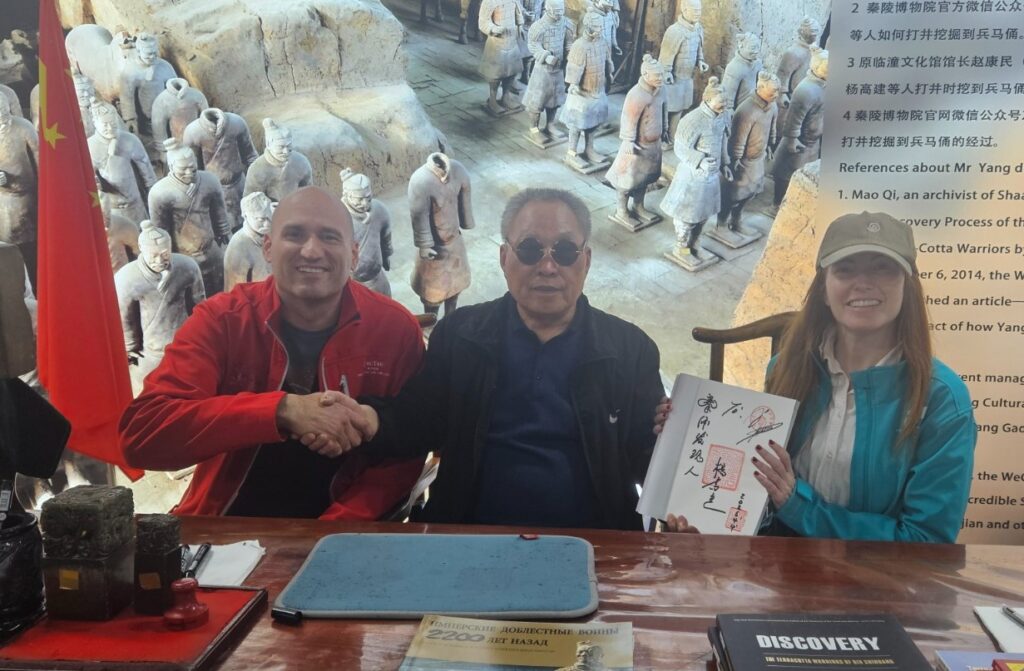
We also bought a book about the site, signed right there by one of the farmers who discovered the site by chance in 1974!! One cool way of exploiting his discovery!
Giant Wild Goose Pagoda
Then we visited the Wild Goose Pagoda, which was extremely popular as well. We had to queue, and show our passports, but the queue moved strangely fast.
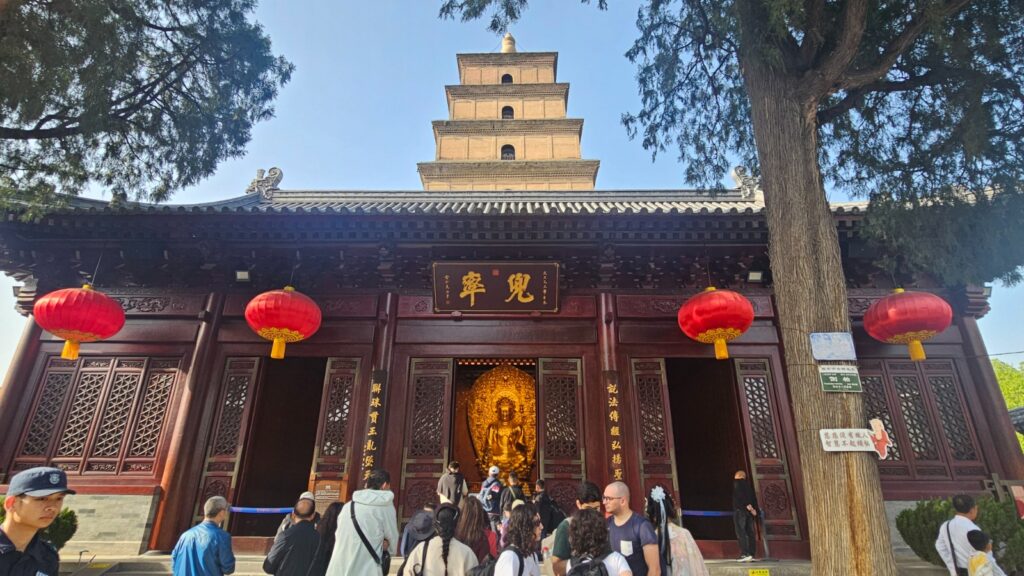
These 3 things were a constant everywhere. Loads of people, over the top checking, but a very organised and efficient transit.
It’s crowded, yes, but it helps that everything is SO BIG. Parks, sites, streets…. distances are massive so all those thousands of chinese people enjoying their leisure can fit in.
The park is lovely, and made even cooler by the fact cherry trees were blossoming (yes, like in Japan 🥰)…
Tang Dynasty dressing
And we saw many, many people dressing up in Tang dynasty style.
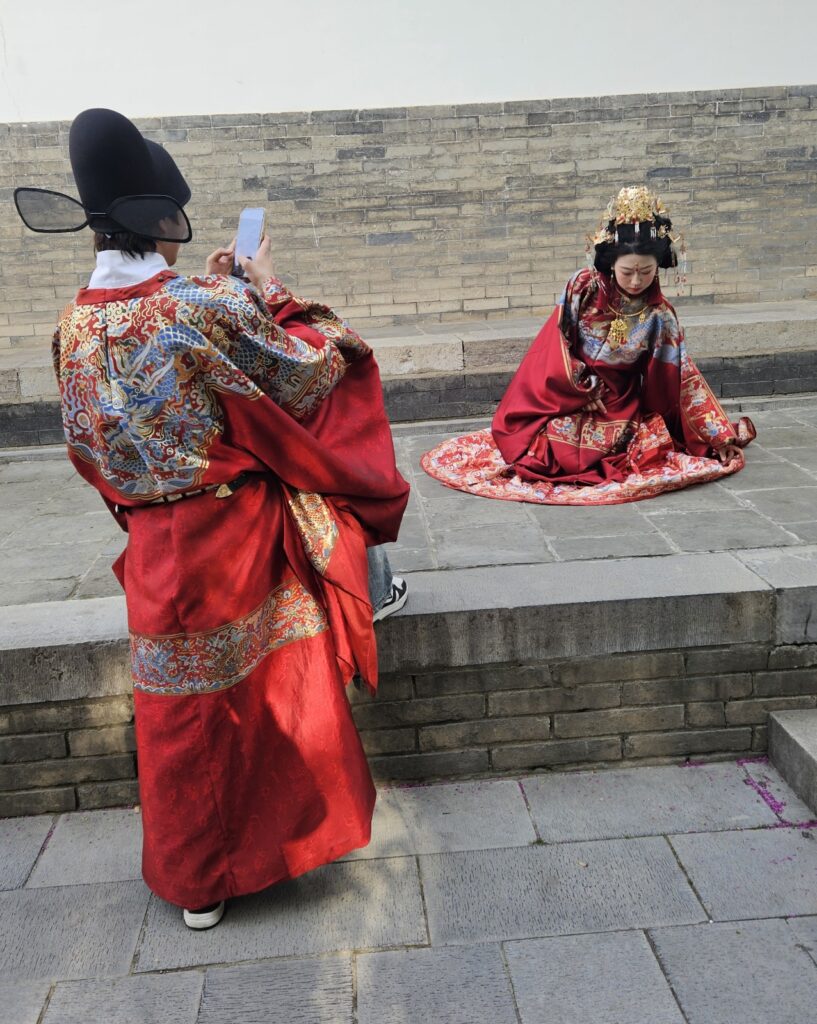
Especially women, but also some families and even men. Tang dynasty was about peace, arts, and culture (as opposed to Qin’s, that was about war 😱). And people LOVE to dress up. It was amazing to see the wonderful attires… and the make up and hairdos. Works of art, really. Annie later showed us where they rent the outfits and do your makeup and hair.
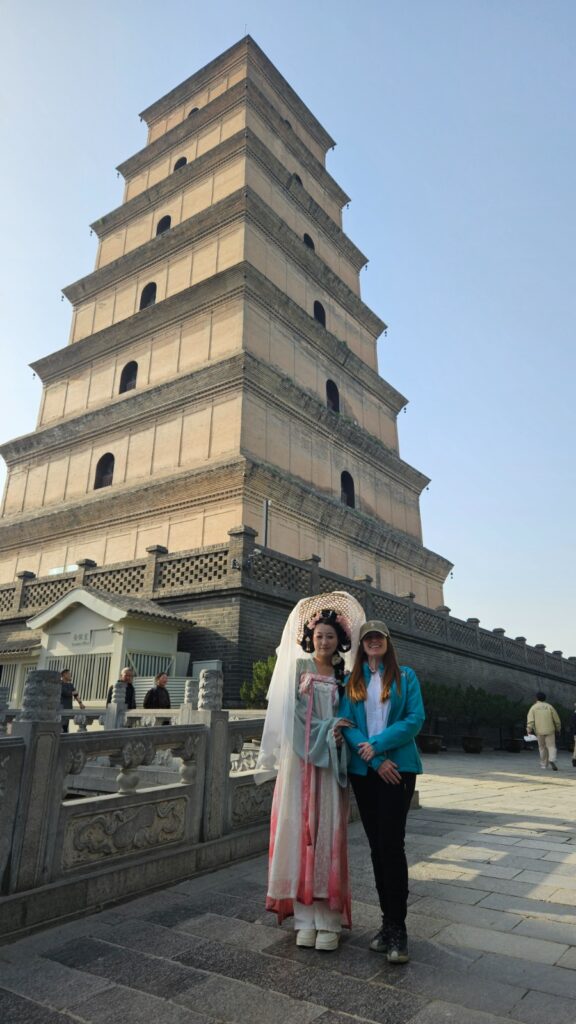
And I even asked a beautiful lady for a picture with her. Seriously lovely 🥰
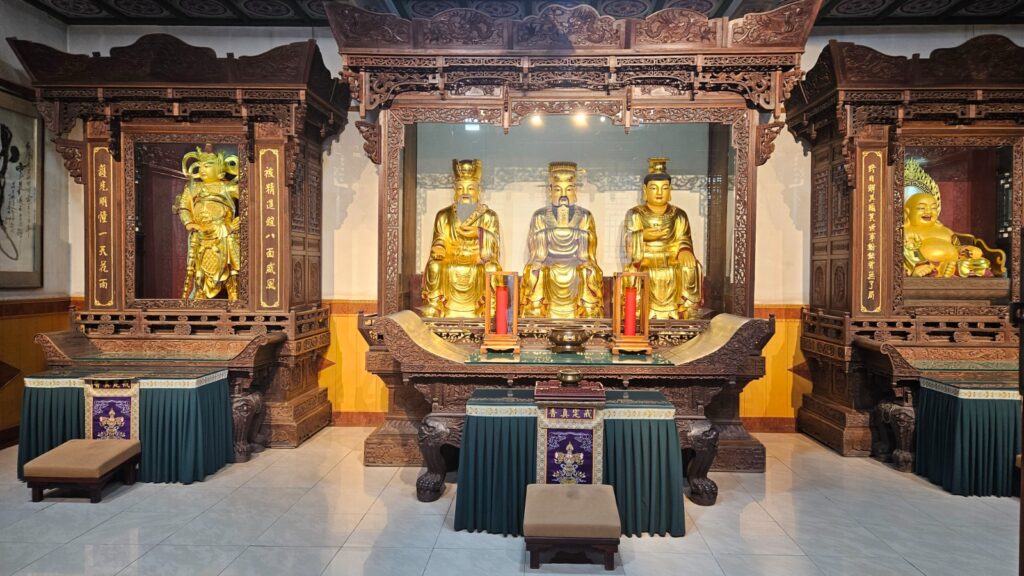
In the park we saw Budas, beautiful temples, people praying and burning incense… we had a great time!
Muslim Quarter living
Our hotel was in a hutong (the traditional chinese small alleys) in the Muslim Quarter.
Great choice! The location was perfect and the hotel was comfortable and decorated in Tang dynasty style!
If you want a unique experience, do stay inside the Muslim Quarter.
After settling in, we went outside to dinner, local style. What a great experience!! I loved walking those streets, crowded and noisy. It was a sensorial experience.
We saw almost no Western tourists, just thousands of Chinese and electric motorbikes zigzagging everywhere (I can’t believe there were no accidents?!)
In the infinite, colourful stalls, food was being sold: steamy big bowls of noodles, meat skewers, soups, roasted chicken, squid skewers, spicy meat, sugar-colored thingies… all kinds of foods, so alien to our Spanish eyes. It was a true festival of smells, tastes, noises… and again I went all in! I had a fried potato skewer and a squid one (it seemed to be very popular and it was tasty!!)
🏃♀️ Running in Xi’an 🏃♂️
Running in the Muslim Quarter, the City Wall and the Park
The day after our visit to the Terracotta Warriors, a Sunday, we went for our run.
The plan? Run in the city wall!
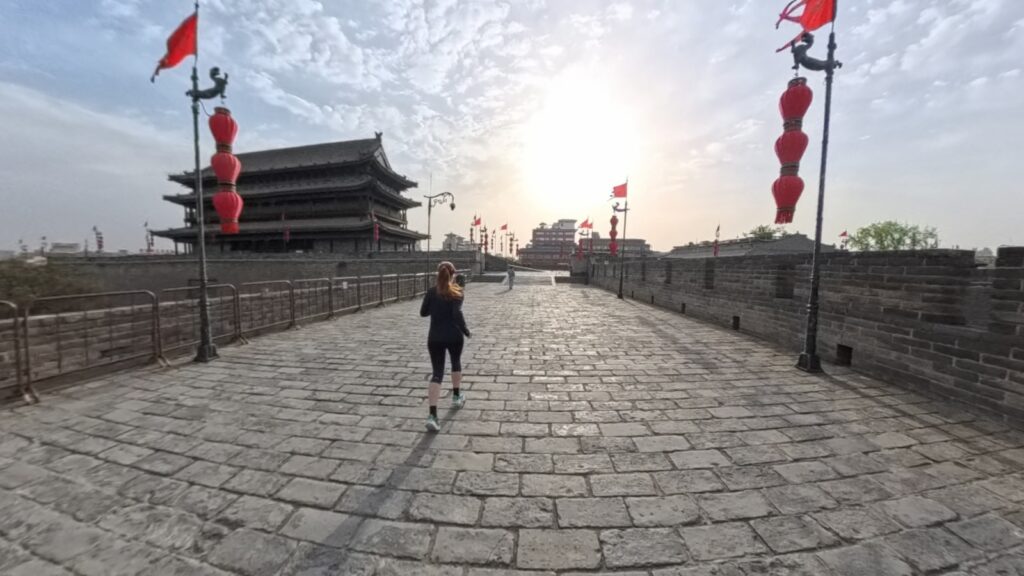
And we did 👍
But we did much more than that! What a great route, what a great experience.
The Muslim Quarter, part I
We left our hutong at 7am because, advised by Annie, we wanted to be at the city wall before 8am (when they open) to avoid the crowds.
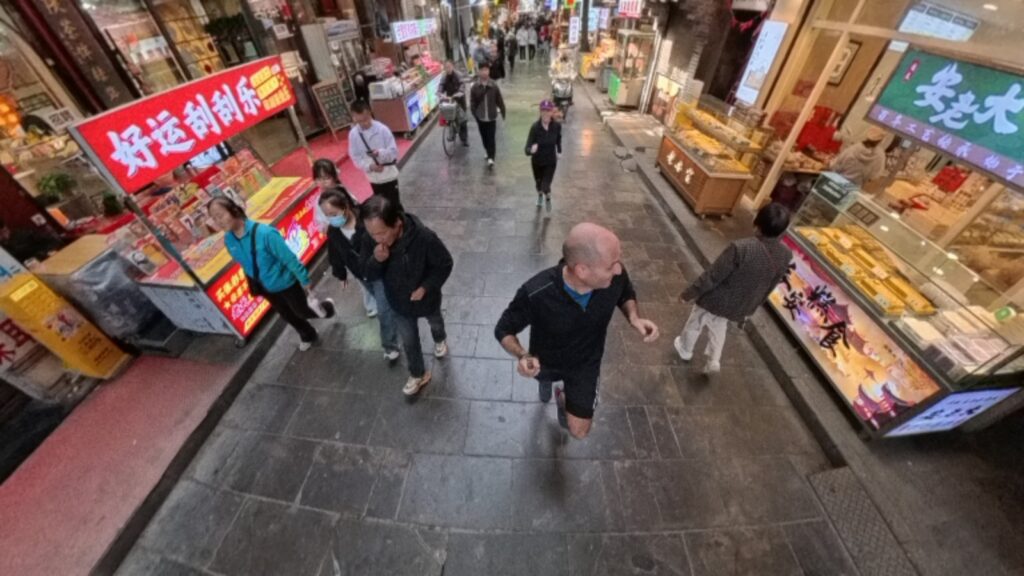
At 7am the streets were already quite lively; the stalls were closed but many people were preparing for a day of intense trading. We ran amongst motorbikes, tricycles and carts transporting goods; driven by local men with the traditional white muslim hats.
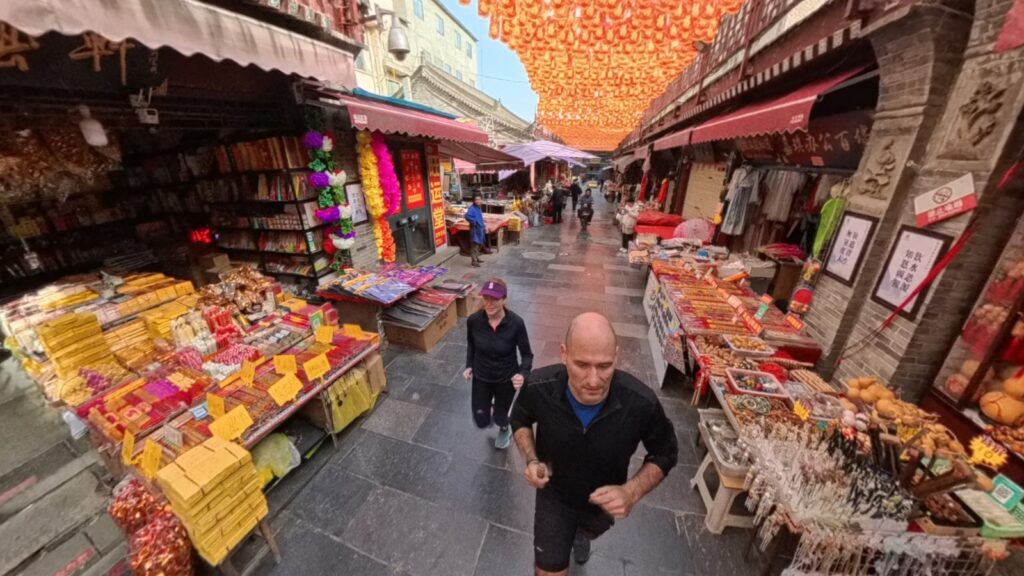
Also we saw a couple of butchers’ shops with locals cutting big (I mean big) pieces of meat, already on display.
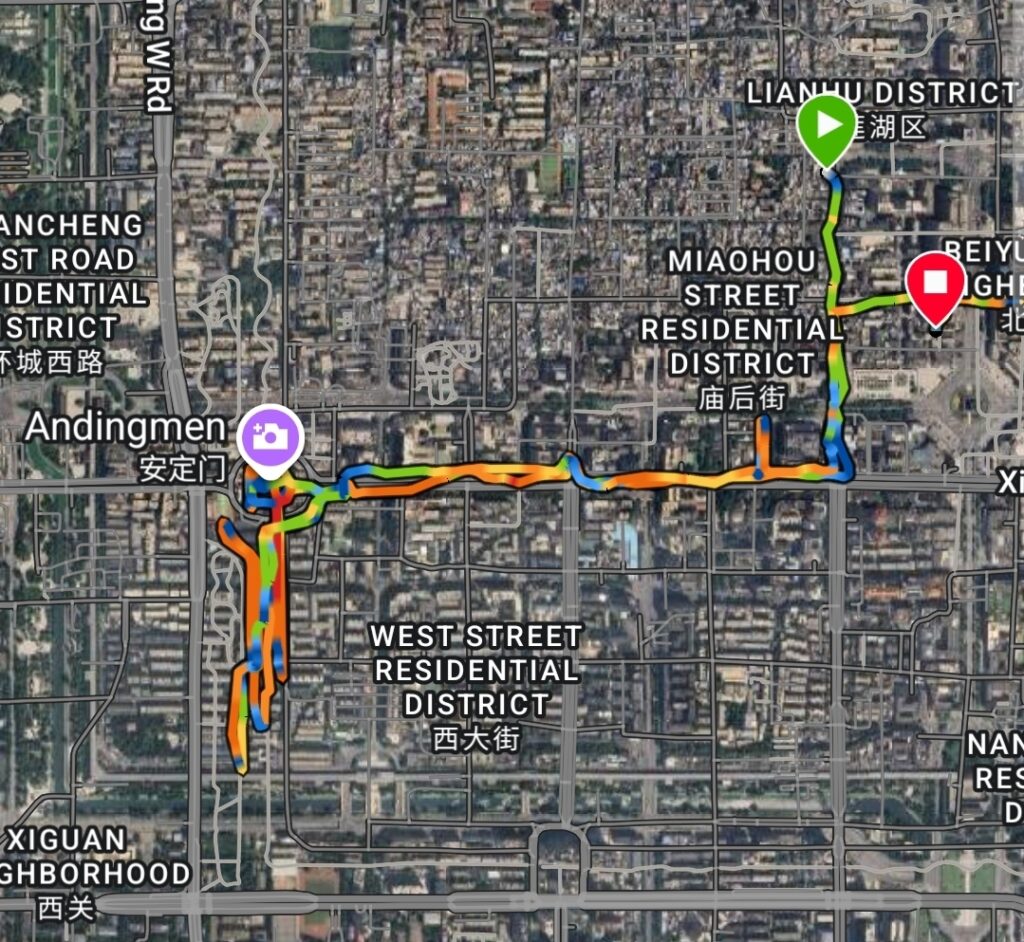
It was perfect temperature and after checking the map (not googlemaps here, but we had installed wechat in advance 😜), we left the Muslim quarter and ran almost 2 kilometers towards the City Wall; along a wide avenue.
Again; all is big here. Also the sidewalks!
And what’s “the city wall is sooo close to your hotel” here, means 2.5 kms away 😜
Running in Xi’an’s city wall
We timed it perfectly and we arrived at the magnificent Changle Gate (the East one) at 7:54. A couple of Chinese were already queueing so we were not technically the first visitors of the day, but close enough. Btw: 3 hours later, when we passed by on our way to the airport, the queue was massive!
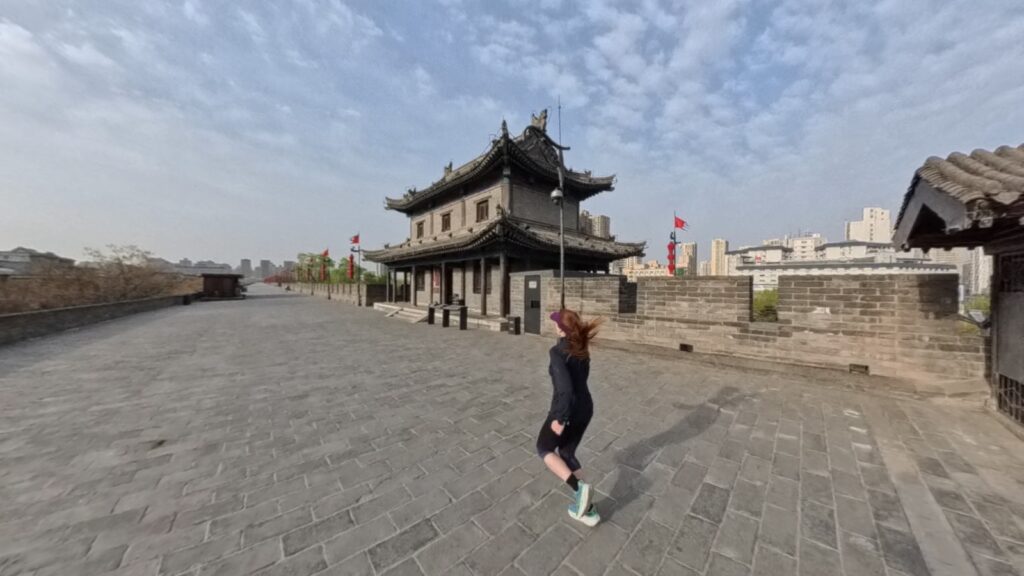
We bought our tickets showing our passports and paying via Alipay (we felt like locals 😜), and then we were able to run in the wall by ourselves.
It was beyond cool.
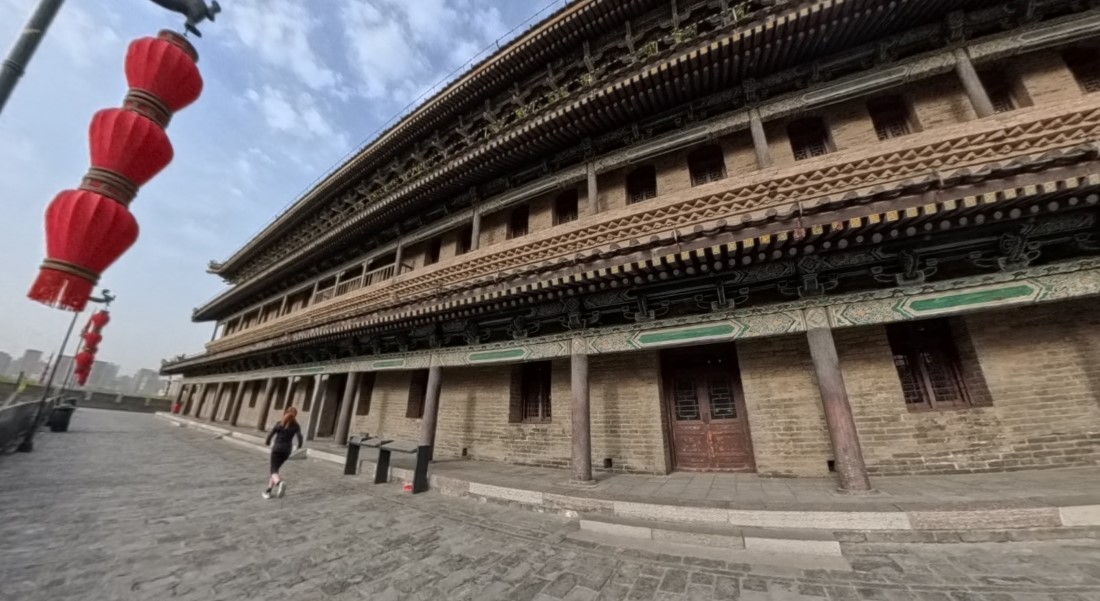
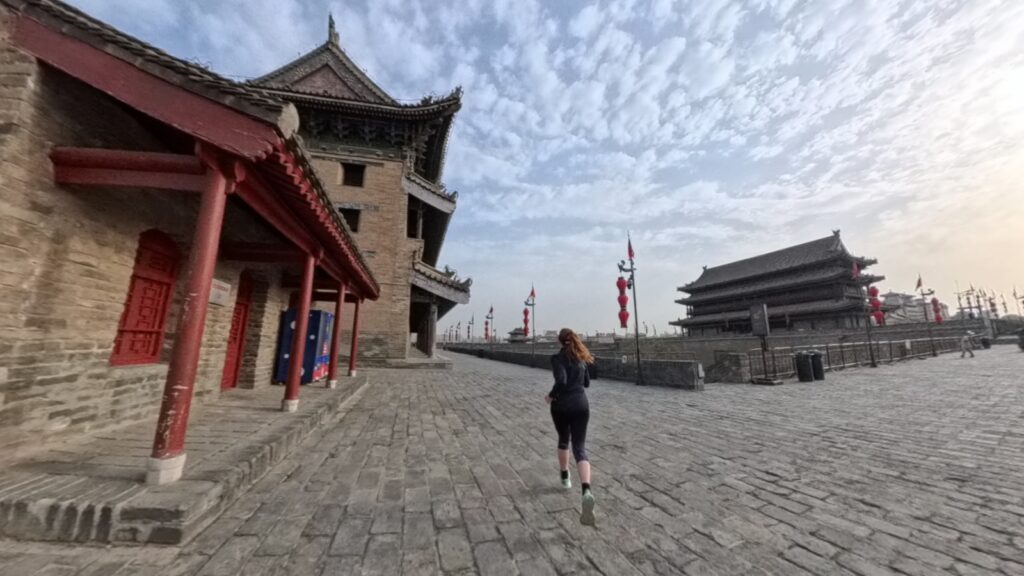
First, from a massive yard enclosed by high stone walls, we went up a few steps 😜 (understatement here, it was way more than a few, it was a steep high staircase, really). And then we were up on the wall. The massive stone gates and wall (it’s 14 kilometers long, no kidding!), were there for us to run in and enjoy.
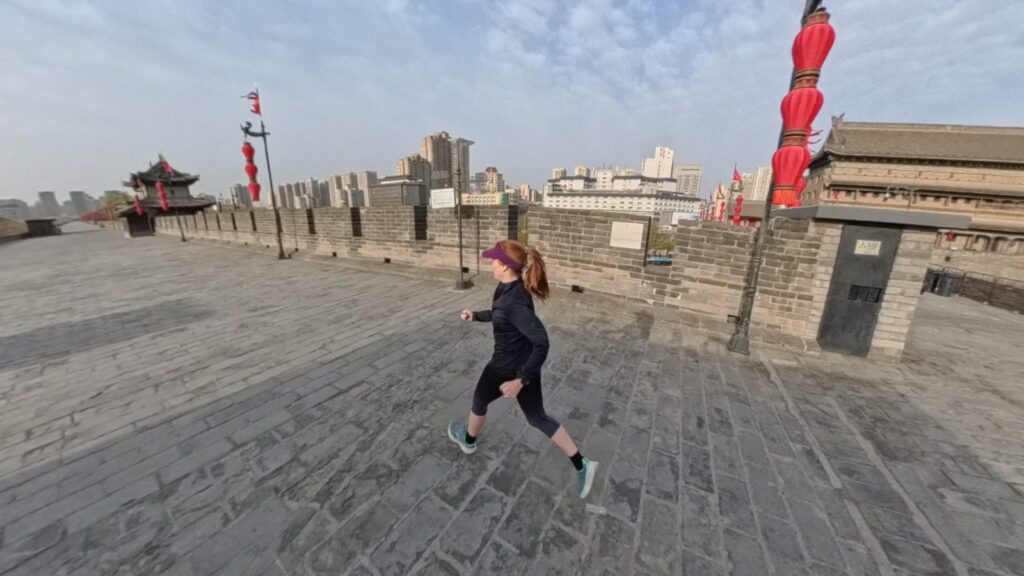
We felt our footsteps echo against the ancient stone pavement while we were seeing the fantasy architecture of those gates. The colours of the wood decorations, the signs with beautiful chinese kanjis, a massive iron bell, red lanterns… it was like we were back in Tang dynasty times.
We ran for a while on the impressive wall, which is also surprisingly wide, while, below, we saw a park, along the wall’s moat, which seemed to be very popular with locals… and runners. So we decided to run there after running in the wall.
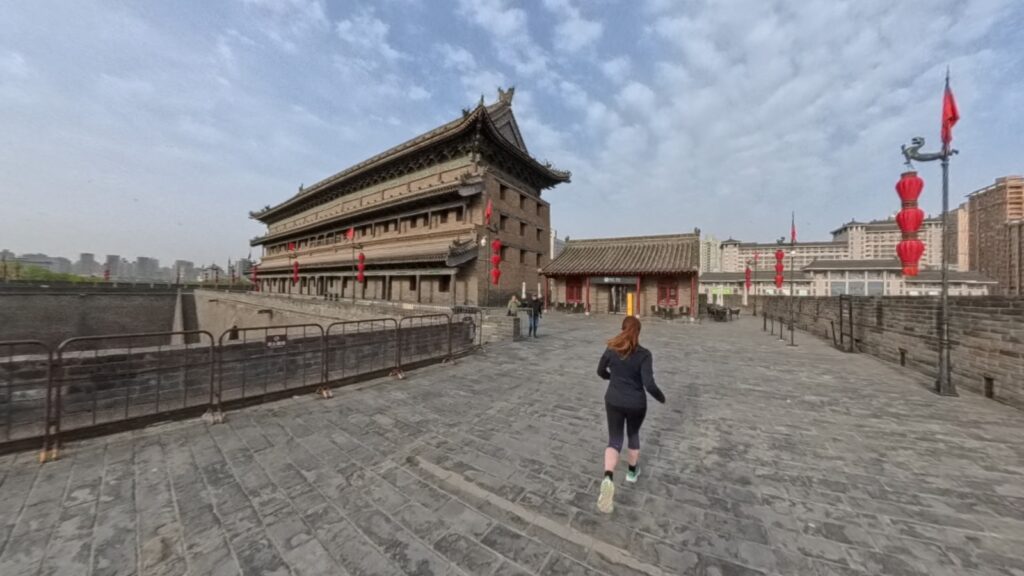
A perfect setting (also for photo shoots)
When we were about to descend, we saw a couple of ladies in super bright red traditional robes, being taken pictures by photographers. It seemed like a very popular activity, but we photobombed them by running down the stairs 😱. Sorry!
Sunday in the Park; Chinese style
Then we ran in the park alongside the wall.
It was a typical Sunday morning, Chinese style. We saw what it is expected from Chinese locals; specially elderly people doing taichi everywhere; some even with swords!
Some groups were very animated, blasting chinese music which to me sounded like local versions of “Modern Talking” 🤣
Ping pong! With people all ages playing very competitively!
Badminton!
Elders briskly walking!
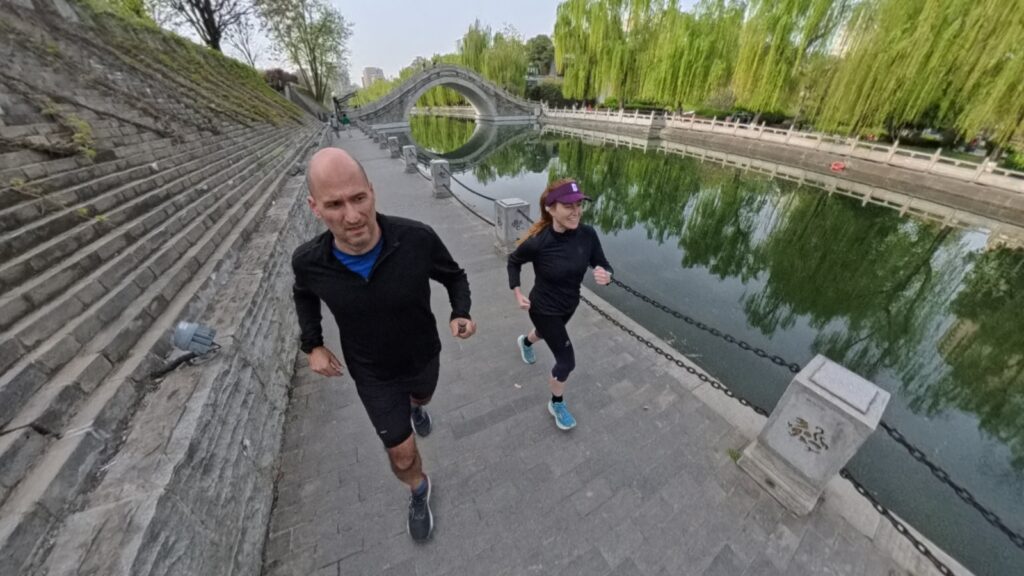
Chinese architecture; round bridges and stone canals lined up with trees!
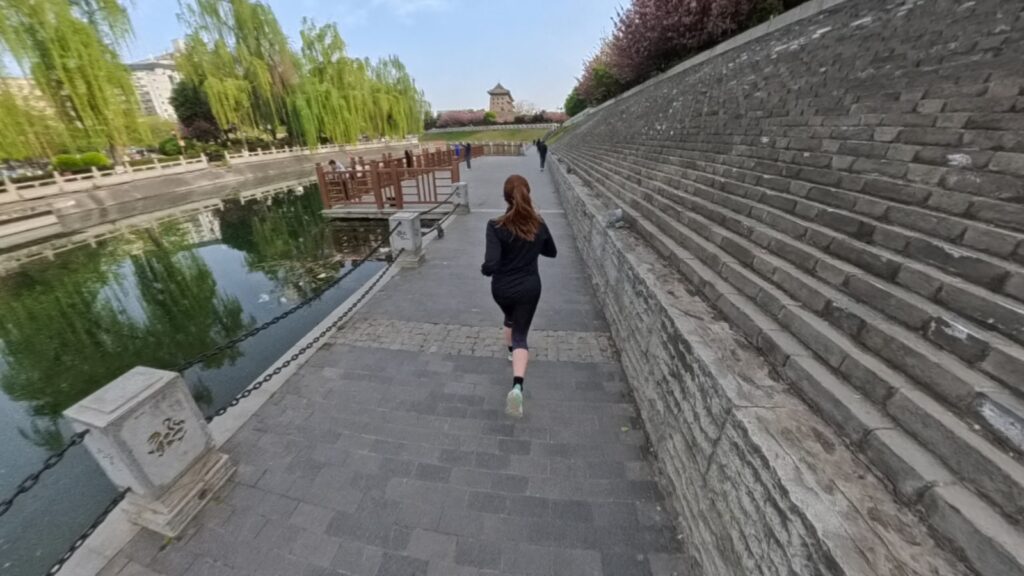
We almost blended in, because many others were jogging 😉, bu not quite, though, as I tried to climb a steep bridge not through the stairs but trough a polished surface in the middle…. and I fell 🤣… to the astonisment of old locals and Roger alike 😱
Anyway; it was the typical chinese bridge over the typical chinese moat (it’s the city wall’s moat!)… so scenic (it even had cherry trees blossoming), that it looked straight out of a scroll painting!
We absolutely loved being part of this.
Last stop: Buddhist temple
On our way back, we did a small detour to enter a big, colourful gate, with two big stone lions (dressed with bright red drapes for the occasion), and run in a hutong with plenty of stalls and people, and a Buddhist temple at the end.
There we witnessed a family burning incense (with a kid being asked to do so and not looking very convinced 😜), before running again down the street, dodging locals and MANY motorbikes.
Muslim Quarter Part 2
And, finally, we did another “adventure run” when we ran the last kilometer in the Muslim Quarter again.
This time it was already 9am and there were a lot of people around.
Many stalls were opened, offering steamy noodles and soups for breakfast.
Roger was tempted, but his stomach was still not up for the job. Next time, though, he promised himself.
We successfully dodged motorbikes, tricycles and people to reach our hotel at 9:15am, after an unforgettable 11km run!
🍜 Carboloading 🍝: What to eat and drink in Xi’an if you are a runner
Chinese food: perfect for before a run!
If you are in China, you already know that you will not be short of choices.
I recommend grabbing a bowl of thick Biang Biang noodles in Xi’an to power your next long urban run, specially in the Muslim Quarter, like we did. These hand pulled ribbons offer the perfect complex carbohydrates needed for an afternoon of exploring the ancient city walls.
“Acerolas Acaramelizadaaaass”
After visiting the Giant Wild Goose Pagoda, we walked down an avenue which was crowded by people walking, eating, and enjoying their Saturday dressed like Tang dynasty courtesans.
Again, massive buildings, temples and statues. Everything is BIG in China. And food stalls everywhere. And then I fulfilled a bucket list item of mine! I ate sugarcoated cherries. When I was a teenager I watched the movie “Farewell to my concubine”, which I loved, and I still remember a fragment when the main characters as kids buy them. The line of the guy selling them (in the Spanish version)stuck with me all these years. “Acerolas caramelalizadaasss, acerolas caramelalizadaasss…”
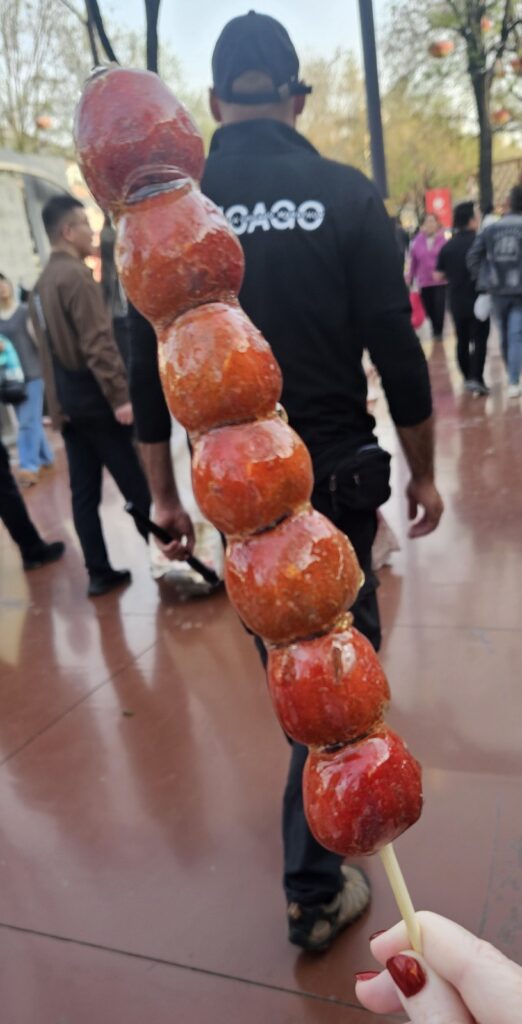
Btw; they were very good. A true sugar bomb, but very tasty nonetheless.
Chinese Tea 🍵
During our tour, Annie took us to a tea shop where we had amazing local teas; crysantenum (with the yellow flowers!), ginseng (good for Roger’s upset stomach), dragon green, pu’er… and lychee black tea which is surprisingly sweet!
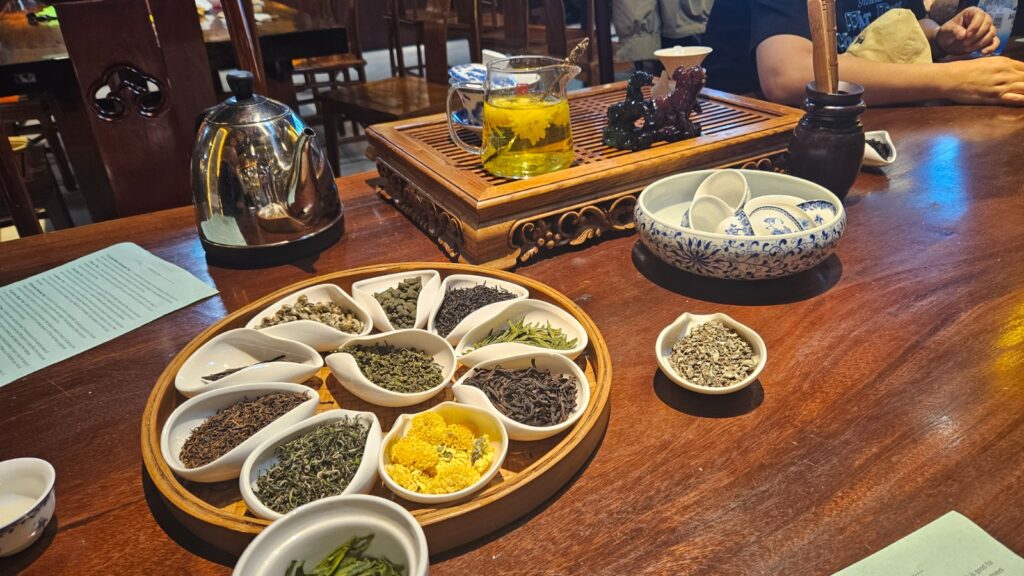
We loved it so much, we bought some 😘.

Useful information
🏃♀️ Xi’an, China.
👟 Urban: bring shoes for asphalt.
✅ Wide avenues; in the morning when they are not too crowded it is very easy to run in. The park has fantastic views!
✅ Atmospheric location, at the feet of the Ancient Wall, and the possibility of mingling with the locals (taichi life!)
⚠️Outside of the park, the streets can be very very crowded.

Map
One book
“Everything under the Sky”, by Matilde Asensi
If you are heading to Xi’an to witness the grandeur of the Terracotta Army, you absolutely must pack a copy of Matilde Asensi’s “Everything Under the Sky” (Todo bajo el cielo). This historical thriller is a masterclass in atmospheric storytelling, blending meticulous research with a high-stakes treasure hunt. Set in the 1920s, the story follows Elvira, a Spanish painter living in Shanghai, who is thrust into a dangerous quest across China following the mysterious death of her husband. Asensi’s writing style is fast-paced and incredibly evocative, making it the perfect companion for a long flight or a train ride through the Chinese countryside. 📚✨
What makes this book truly “cool” to read while visiting Xi’an is how it transforms the Terracotta Warriors from static statues into a living, breathing mystery. As you stand before the pits of the mausoleum, Asensi’s vivid descriptions of the “underground palaces” and the rivers of mercury mentioned in ancient texts come rushing to your mind. 🏺🐎 It adds a layer of intrigue and “Indiana Jones” excitement to your visit, allowing you to look past the crowds and imagine the hidden chambers that still remain unopened to this day. Reading it on-site makes the history feel less like a museum exhibit and more like a thrilling, unsolved puzzle! 👣🔍
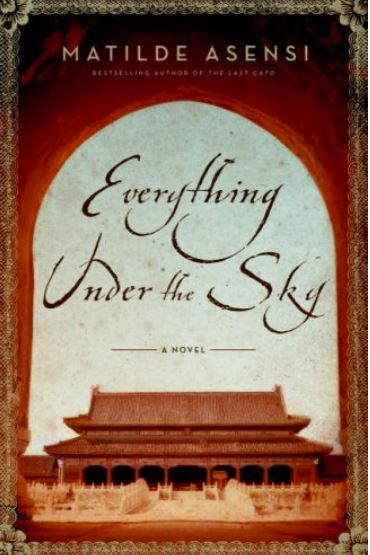
Plot Summary: The plot is a pulse-pounding race to uncover the greatest archaeological secret in history: the true location and treasures of the First Emperor’s tomb. Guided by an ancient silk map and a series of cryptic riddles, Elvira and her motley crew—including her niece and a wise antiques dealer—navigate secret societies, treacherous landscapes, and the looming threat of the Japanese invasion. 🗺️⚔️ It’s a “Da Vinci Code” style adventure but with a distinctively Eastern flavor, focusing on the philosophy of the First Emperor, Qin Shi Huang, and the legendary booby traps said to protect his eternal resting place. 🏹💎